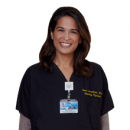
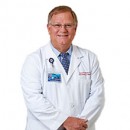
Meet Sandy Kertz
ST. LOUIS – When SSM Health Saint Louis University Hospital founded the MidAmerica Stroke Network in 2008, the goal was to help improve stroke outcomes at rural Missouri and Illinois hospitals. While the network has grown to 54 hospitals and has saved countless stroke victims, it also helps in treating trauma patients as well.
“When we think of the network, you consider the ease of sharing CT scans in terms of stroke, but there is also considerable benefit for those with traumatic head injury,” says Eli Feen, MD, director of the stroke network and a SLUCare neurologist at Saint Louis University Hospital. “The speed of relaying critical patient information can make every difference in a patient’s outcome.”
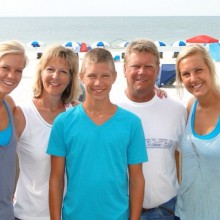
For Sandy Kertz of south St. Louis County, she is living proof that every second counts.
On August 10, Sandy and her family were visiting friends in her hometown of Ste. Genevieve when she went up steps to retrieve her phone charger.
“I was going up the steps and my sandal slipped on the third step,” says Sandy. “I fell backwards and everyone heard my head pop on the concrete.”
While there was no external bleeding, it was soon apparent there were serious problems. “I said I was OK, but soon I couldn’t remember how many kids I had and I became unresponsive and started throwing up within twenty minutes.”
An ambulance took Sandy to nearby Ste. Genevieve County Memorial Hospital, a member of the MidAmerica Stroke Network. A CT scan of Sandy’s brain found an epidural hematoma, a traumatic brain injury where blood builds up between the outer membrane of the central nervous system and the skull.
Physicians in the Ste. Gen emergency department knew time was critical – in the same way an ischemic stroke carries the moniker “time is brain.” With that mindset, Michael Kolda, MD, emergency medicine physician at Ste. Gen, made the call to airlift Sandy to Saint Louis University Hospital, while utilizing the stroke network’s system of sharing images. Dr. Kolda was able to quickly send the CT scan to SLU Hospital and contact SLUCare neurosurgeon Ann Marie Flannery, MD.
“Dr. Kolda called the access line and he knew the patient was in trouble,” says Dr. Flannery. “As part of the stroke network, we were able to see the images before the patient even got here.”
By looking at the CT scan while Sandy was in the midst of being transported by air, Dr. Flannery immediately knew what surgical treatment was necessary. “Thanks to those images, we didn’t have to do any repeat studies,” she says.
When Sandy landed that Saturday night, she was taken straight to the operating room. “She came in with a blown pupil – a real sign of increased pressure and an ominous sign,” she says. “We needed to move and within 30 minutes we removed the blood clot.”
The craniotomy performed by Dr. Flannery and her team stopped the bleeding and removed a substantial clot.
A brief hospital stay was followed by a brief stay at a nearby rehabilitation hospital. Within a couple of weeks Sandy was back home with her husband and three children.
“I’m a nurse and I didn’t have an awareness of how critical I was,” says Sandy. “I’m thankful that Ste. Gen has that ability to transfer so easily because it preserved who I am and saved my life.”
“It’s testimony to the effort we make to treat complex cases,” says Dr. Flannery. “Times like this are when it shows.”

Meet The Specialists